YK-M2 人急性髓系白血病细胞株 BioVector® YK-M2 Human Acute Myeloid Leukemia Cell Line
- 价 格:¥99880
- 货 号:BioVector® YK-M2
- 产 地:北京
- BioVector NTCC典型培养物保藏中心
- 联系人:Dr.Xu, Biovector NTCC Inc.
电话:400-800-2947 工作微信:1843439339 (QQ同号)
邮件:Biovector@163.com
手机:18901268599
地址:北京
- 已注册
BioVector® YK-M2 人急性髓系白血病细胞株
BioVector® YK-M2 Human Acute Myeloid Leukemia Cell Line
第一部分 中文说明
一 产品基本信息与遗传学背景
细胞名称:BioVector® YK-M2 人急性髓系白血病细胞
系统学 Accession:Cellosaurus CVCL_A726
保藏机构货号:DSMZ ACC 949
物种来源:人类 (Homo sapiens)
性别与年龄:男性,65岁(Japanese 种群背景)
组织与疾病背景:该细胞株于2011年建立,源自一名患有急性髓系白血病部分成熟型(Acute Myeloid Leukemia, FAB分型为 M2 型)的65岁日本男性患者的骨髓(Bone marrow)外周血单核细胞组织。
核心致癌分子与突变特征:
RUNX1-RUNX1T1 融合基因(即 AML1-ETO 融合):该细胞株由于伴有染色体隐匿性易位 $t(8;21)(q22;q22)$,导致转录因子 RUNX1(旧称 AML1)与编码核辅阻遏物的 RUNX1T1(旧称 ETO)基因发生融合。该融合蛋白通过阻断造血分化核心靶基因的转录,是 AML-M2 型白血病中最核心的致病分子标志物之一。
复杂的继发性突变谱:除了经典的 $t(8;21)$ 外,通常还伴有其他协同突变(如 KIT、FLT3 或表观遗传调节因子的变异),共同驱使细胞实现恶性无限增殖和分化阻断。
生物安全级别:1级(BSL-1)。
二 细胞形态学与培养环境
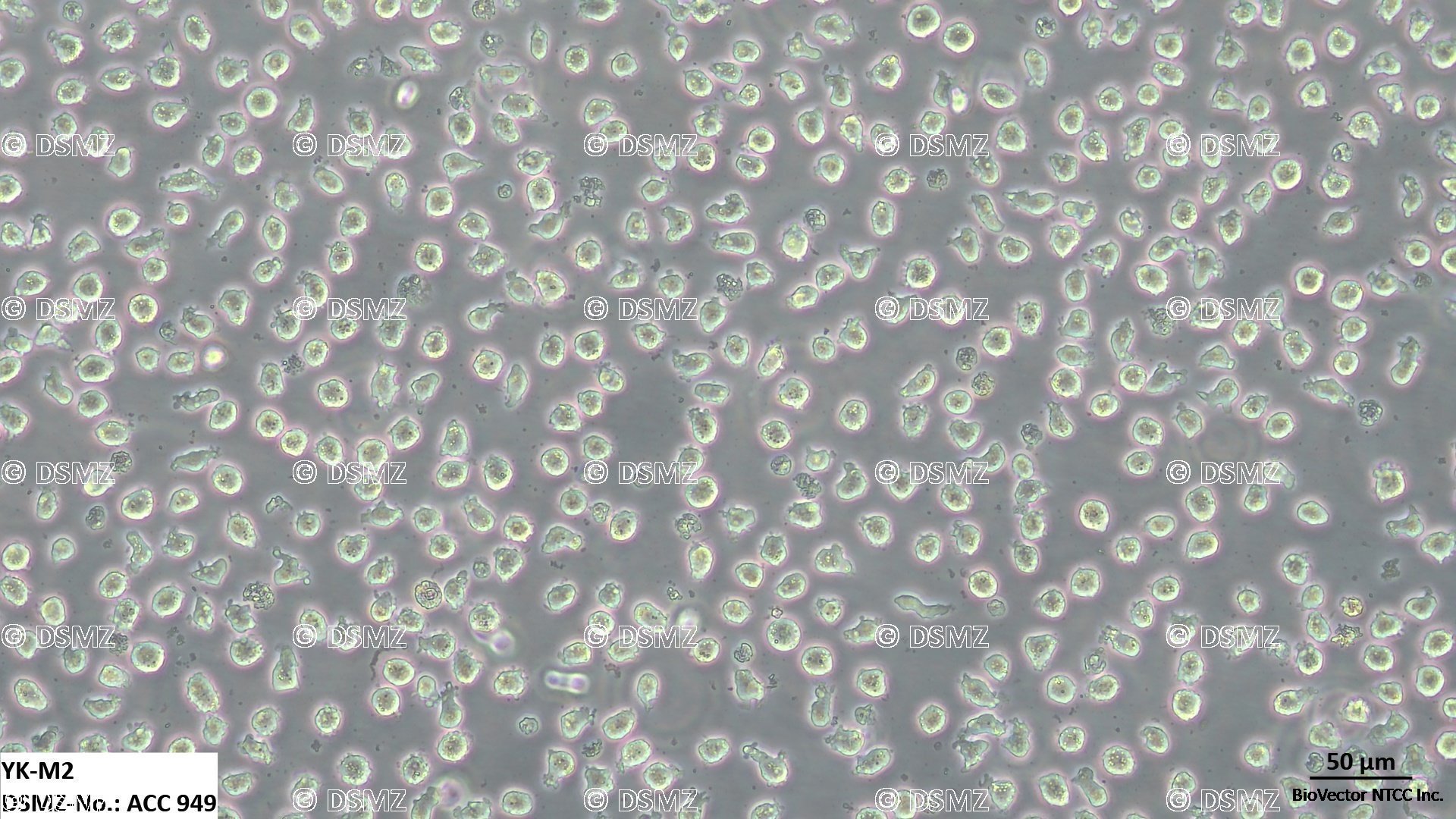
形态学特征:展现典型的原始白血病髓系细胞形态。显微镜下胞体呈中等大小、圆形或卵圆形,核质比高,在培养液中以分散悬浮的单细胞形式生长。
生长模式:完全悬浮生长。
密度依耐性与敏感特征:
该细胞对低接种浓度和环境波动极其敏感。当细胞密度过低时(如低于每毫升 $2.0 \times 10^5$ 个活细胞),细胞由于缺乏自分泌生长因子的相互支持,会迅速进入停滞期并倾向于发生大规模自发性凋亡。
在复苏早期,细胞生长通常较为迟缓,极易形成团块状或轻微结块现象,属于该株的正常生理表型。
标准完全培养基配方:
基础培养基:BioVector® RPMI-1640 培养基。
维持添加:
15% 到 20% BioVector® 优质热灭活胎牛血清(h.i. FBS)。高浓度优质血清是维持该株存活和抑制复苏早期衰退的关键。
1% Penicillin-Streptomycin 双抗溶液。
物理培养参数:37摄氏度恒温、5% 二氧化碳、空气饱和湿度。
三 细胞传代与复苏标准操作步骤
常规传代操作:
核心维持密度:在日常扩增过程中,务必将活细胞密度严格控制在 每毫升 $3.0 \times 10^5$ 至 $1.5 \times 10^6$ 个活细胞 之间。
当细胞密度接近每毫升 $1.5 \times 10^6$ 个上限,或者培养基由于乳酸大量蓄积而明显变黄时,必须进行传代。
将细胞悬液转移至无菌离心管中,以 150 g 至 200 g 离心 5 分钟,彻底弃去旧培养基。
接种策略:加入新鲜预热的完全培养基重悬,推荐起始接种密度控制在每毫升 $3.0 \times 10^5$ 到 $4.0 \times 10^5$ 个活细胞。常规传代比例通常为 1比2 至 1比3,每 2 到 3 天需要补液或传代一次。
冻存细胞复苏:
从液氮罐中快速取出冷冻管,立即投入 37摄氏度 BioVector® 水浴锅中持续高频摇动使其快速融化,严格控制在 1 到 2 分钟内。
迅速将解冻的细胞液移入含有 5 到 7 mL 预热高血清完全培养基的无菌试管中,150 g 离心 5 分钟以彻底去除残留的 DMSO 冻存液。
弃去上清,加入 4 mL 新鲜完全培养基重悬,接种至小培养瓶中,保持相对较高的初始复苏细胞密度(建议 $\ge 5.0 \times 10^5$ cells/mL),并在前 24 小时内尽量避免剧烈晃动或频繁移出培养箱。
四 核心科研应用方向
$t(8;21)$ / RUNX1-RUNX1T1 阳性白血病的靶向药物筛选:BioVector® YK-M2 是国际上研究 $t(8;21)$ 核心靶点极为稀缺且珍贵的内源性标准细胞模型。常被用于评估和筛查针对 RUNX1-RUNX1T1 融合蛋白的新型阻断剂、促其降解的小分子化合物(如组蛋白去乙酰化酶抑制剂 HDACi 的联合应用),以及针对伴发 KIT 突变靶点的激酶抑制剂药效学测试。
髓系分化阻断与转录调控网络机制研究:利用全反式维甲酸(ATRA)、维生素D3(Vitamin D3)或佛波酯(TPA)等诱导剂干预 YK-M2 细胞,通过定量监测其细胞表面分化抗原(如 CD11b、CD13、CD14、CD33)的切换谱,用于解密 RUNX1-RUNX1T1 融合蛋白在表观遗传学层面上压制髓系造血分化、诱发白血病发生的分子闭环。
AML 难治耐药性与免疫微环境逃逸研究:由于该细胞源自临床恶性进展期髓系病例,常用于建立免疫缺陷小鼠(如 NCG 或 NSG 小鼠)的异种移植白血病模型(PDX-like cell model),在体内或体外微环境压力下分析急性髓系白血病对常规化疗药物(如阿糖胞苷 Ara-C、柔红霉素)产生耐药的动力学特征及免疫检查点配体的转录调控。
PART 2 ENGLISH SECTION
I General Information and Genetic Background
Cell Line Name: BioVector® YK-M2
Synonyms: YKM2, YK-M2
Cellosaurus Accession: CVCL_A726
Repository Catalog Number: DSMZ ACC 949
Species Origin: Human (Homo sapiens)
Sex and Age of Donor: Male, 65 years old (Japanese population profile)
Tissue and Disease Background: Established in 2011 from the peripheral blood mononuclear cells / bone marrow aspirate of a 65-year-old Japanese male patient diagnosed with Acute Myeloid Leukemia with maturation (FAB classification: AML-M2 subtype).
Core Oncogenic Markers & Genomic Traits:
RUNX1-RUNX1T1 Gene Fusion ($t(8;21)(q22;q22)$ variants): Characteristically harbors the hallmark reciprocal chromosomal translocation $t(8;21)$, fusing the core binding factor subunit RUNX1 (formerly AML1) to the nuclear corepressor RUNX1T1 (formerly ETO). The resultant chimeric protein acts as a dominant-negative transcriptional repressor that shuts down downstream hematopoiesis master genes, serving as a primary driver mechanism for M2-subtype leukemogenesis.
Secondary Mutational Profile: Accompanied by overlapping clonal mutations (e.g., in KIT, FLT3, or epigenetic modifier networks), which cooperatively accelerate proliferation and lock differentiation sequences.
Biosafety Level: BSL-1.
II Morphological Attributes and Cultivation Media
Morphology: Displays classic primitive myeloid blastic architecture. Under standard light microscopy, cells present medium-sized, round or oval profiles with prominent nucleoli and high nuclear-to-cytoplasmic volume ratios, expanding strictly as an unattached single-cell suspension.
Growth Mode: Suspension growth.
Density Dependency & Sensitivity Indicators:
Highly vulnerable to low biomass initial settings. If the cellular seed density plummets below critical thresholds ($< 2.0 \times 10^5$ viable cells/mL), proliferation ceases due to the exhaustion of essential autocrine growth factors, frequently leading to culture crash or mass apoptosis.
During immediate post-thaw phases, cell expansion typically lags, and temporary cell clumping or micro-aggregation may manifest, which represents an intrinsic physiological feature of this specific line.
Standard Complete Growth Medium Formulation:
Basal Medium: BioVector® RPMI-1640 medium.
Routine Supplements:
15% to 20% premium BioVector® Heat-Inactivated Fetal Bovine Serum (h.i. FBS). Sustained high serum titers are mandatory to preserve baseline fitness and buffer against post-thaw viability decline.
1% Penicillin-Streptomycin solution.
Physical Incubation Thresholds: Regulated strictly at 37 degrees Celsius under an atmospheric layer of 5% Carbon Dioxide and saturated air humidity.
III Subculturing and Thawing Protocols
Routine Passaging Schedule:
Core Density Window: Maintain the active suspension profile tightly bounded between $3.0 \times 10^5$ and $1.5 \times 10^6$ viable cells/mL.
Subculture the vessel when the biomass density reaches or approaches the $1.5 \times 10^6$ cells/mL baseline, or when the phenol red parameters shift heavily towards yellow due to lactic acid accumulation.
Pellet the suspension via centrifugation at 150 g to 200 g for 5 minutes, and draw off the spent broth.
Seeding Target: Resuspend the cells in fresh pre-warmed complete medium. Crucially, never re-seed fresh cultures at densities lower than $3.0 \times 10^5$ viable cells/mL. The recommended split sequence averages 1:2 to 1:3, demanding medium replenishment or subculturing every 2 to 3 days.
Cryovial Thawing and Recovery:
Retrieve the cryovial from storage and submerge it into a 37 degrees Celsius BioVector® water bath with rapid agitation until completely liquefied within 1 to 2 minutes.
Promptly transfer the cell suspension into a sterile tube carrying 5 to 7 mL of pre-warmed complete growth medium and spin at 150 g for 5 minutes to fully purge residual DMSO.
Decant the supernatant, gently resuspend the cell pellet in fresh, serum-enriched complete BioVector® medium, and plate. Maintain a high cell density baseline ($\ge 5.0 \times 10^5$ cells/mL) during the immediate post-thaw phase and minimize physical disturbance for the first 24 hours.
IV Strategic Research Applications
t(8;21) / RUNX1-RUNX1T1 Target Therapeutic Screening: BioVector® YK-M2 stands as an excellent, scarce endogenous reference model for exploring therapeutic interventions against $t(8;21)$-driven AML. It is widely utilized to screen small-molecule inhibitors targeting the RUNX1-RUNX1T1 multimerization domain, evaluate molecular glue degraders, or test combination regimens incorporating HDAC inhibitors and secondary KIT kinase blockers.
Elucidating Myeloid Differentiation Blockades and Transcription Networks: Deployed alongside chemical differentiation vectors (such as All-Trans Retinoic Acid ATRA, Vitamin D3, or TPA) to track alterations in immunophenotypic clusters (measuring variations in myeloid antigens CD11b, CD13, CD14, and CD33), helping to decode the epigenetic mechanisms by which the fusion complex arrests hematopoietic maturation.
AML Refractory Resistance and Xenograft Modeling: Since it originates from a clinically advanced myeloid malignancy case, this line is heavily used to construct cell-line-derived xenograft (CDX) leukemia models in immunodeficient mice (e.g., NSG or NCG strains). It serves to track in vivo resistance kinetics against conventional chemotherapeutic agents like Cytarabine (Ara-C) or Daunorubicin, while profiling immune checkpoint ligand evasion mechanisms.
BioVector NTCC质粒载体菌株细胞蛋白抗体基因保藏中心
电话:400-800-2947
工作QQ/微信同号:1843439339
网址http://www.biovector.net
- 公告/新闻